Tuesday, April 7, 2015

Human Cloning

So today in my photography class there was a joke made about human cloning, and I just stumbled across a video on this subject matter and found it disturbing.... The introduction part of it is what is creepiest in my opinion.
See for yourself!

Wednesday, March 25, 2015

"This Is My Photo Story From Israel: Final Edits" by Jared Polin


This is a way different approach to multimedia photo stories. This guy, Jared Polin, not only explains into detail his photos but shows you exactly what he is talking about. Polin even tells you how he went about taking the picture and why he edited it the way he did. In the bottom left side you can see him talking with the microphone right in front of his face. That's literally the only sound there is.
I chose this because it's different. There's a lot to learn from how he went about taking the images.
From a photo story point of view, it's not very story like. From a technical point of view it's definitely helpful.
His photographs are powerful and well composed and I enjoyed them, but I wish it was more like the other video I watched instead. This is great for future reference for my own photography though.

Bongo Fever by: Chien-Chi Chang

I chose this multimedia photo story mostly on a whim. Since Chien-Chi Chang was presented yesterday in class, I came across this photo story and decided to give it a try. I liked what I learned in class about Chang in class. When I stumbled across this by chance (found it on the Magnum in Motion website) I decided that I was going to do it on this. The title was the first thing that pulled me in because I didn't read the description.
From a young age, in school we are taught that drugs are bad. I've always found stories about drug users very intriguing. I've read far too many books about drug users and talked to a few drug users too. Their stories are all interesting to me, because I've never done any drugs (not that I ever plan on it since I know there's no turning back once you do).
I think Chien-Chi Chang did a wonderful job on this. He captured the sights and sounds perfectly. If you are on the squeamish side, then this will definitely bring that out in you because of the photos of syringes being used. It's very... not brutal (well, I guess in a way it is), but more audacious than anything.
The sounds make you feel as if you are there. It starts of with sounds of city-ish life. You can hear people huffing & puffing out of various drugs, along with heavy breathing. Three lines stood out to me most: "Everyone wants to stop, but no one can." "Your addiction is every day." and "Trust your friends." The last quote was talking about having to trust your friends when you use the same syringe as them, and basically hope for the best that they're not infected with HIV.
Something that caught my eye in this photo story is the use of photos that make it look more like a stop motion (so continuous shots). There were also videos put in and that was good, because it wasn't over done either. There was some text, but mostly used as subtitles so you can understand when a person was speaking and what they were saying.
The photo story starts off with a scene of people outside during the night. Then dives directly into images of people using syringes, and it just now occurred to me (after watching it for a third time) that this video is just as much about HIV as it is about drugs, since in this case they go hand in hand. At the very end, it shows you how the syringes are just everywhere on the ground and there are slugs crawling (for lack of a better word) over and under the syringes.

Wednesday, March 18, 2015

We Connect! Workshop (Book Assignment)


We Connect! is basically to get people to get to know each other if they will be doing some sort of collaboration in the future. In this case, it was a group of students of various majors that are literally working on some sort of rocket-ship science for Nasa. They did would choose cards and then introduce themselves and talk about whatever the question on the card asked. After asking and answering the questions, they had to do the exercise that was on the back of that card. Regardless of there being 3 GoPros and 2 dSLRs being pointed at them, they didn't seem to notice them.

My biggest problems were that it was artificial lighting (this took place at about 6pm back in January), and they were moving too quickly for me to be able to focus on them. There were also too many people to try and capture while focusing on a pair. I needed as many pictures as possible so that I'd have a few good ones, especially since I did this for an actual person, and not just for myself.

Wednesday, March 4, 2015

Understanding Comics by: Scott McCloud (Response)


When I first started to read Chapter 3, my first thought was, "Hey! I used to think the same way as a child! I'm glad I am not the only one!"


As I went further into reading it, it made me realize how little we think about closure. It's something so natural to us, that we don't dive further into thinking about it. The only time we think about closure is if we are creating something: a story, a photograph, a painting.
In photography we use closure when we are trying to convey a story... It's easier to show a story in more than one image and create closure and help guide your viewer into what direction you want them to see the story.
The example above is brilliant, because everyone definitely interprets things differently. Personally, from the comic above, I interpreted as if the guy screaming, "NO! NO!" is trying to save a kitten from the crazy ax man. Someone else might interpret it as the guy being murdered for stealing the crazy ax man's teddy bear. Everyone may interpret things differently.
This is excellent to look at because it helps thinking about positioning my own photography together to show a story. It shows the effect two images has next to one another.
I've noticed that whenever I position images together I tend to do this. If I were to do this, I'd need to actually write captions along with my images. However, if the audience is creative enough, they can very easily fill in the gaps with their own experience and knowledge and it is a whole new experience.
This made me think of this past summer when I went to a photography class my cousin was taking. The guy who was teaching the class was telling us about how there is never a single moment in a photograph if it's like the one above. Each person tells a separate moment and/or story. We should keep that in mind when taking photos of people and focus on a single thing that is going on, not the full moment. It's too much to take in for a single person, I think. They might also not think too much about what's actually going on, and you want them to think about it.

To me this is routine. Routine can be in every day life, but also life in general. This sort of thing happens to multiple people. People every where can relate to this. It shows time passing by in a very interesting way.
Overall, I found both chapters very interesting and insightful to read. There is so much potential in each photograph that has ever been photographed to be turned into a massive story (which I think would be super awesome to see done). Everything depends on the content of the image and the way they are put together.


(Now I have many ideas for different projects. Reading is one of many great ways to get inspired.)

Wednesday, February 25, 2015

Photo Story Documentaries

Beneath The Streets of Romania's Capital, A Living Hell


I stumbled across this article while searching the web for a photo story of the Romanian people. I decided to first watch the video of this to see and hear what it was about before actually reading it. I will warn you that it is kind of graphic, so beware.
I chose this because I wanted to see what else I can learn about Romania. Being born in the US and never having any Romanian history taught to me, this is how I learn about my family's country.
Having gone to Bucharest way too many times for me to even count, I never knew about these tunnels. I have never even thought about real people living in tunnels.
Personally, I think that this was a great topic for a documentary. It teaches people about what goes on under their city. Not many people think about what could possibly go on at night in the streets or below the surface.
These people were in orphanages when Ceausescu, once Romania's communist president, was in power. I think that to them, that was a much better life because they were in the care of the "state". Once communism fell apart in Romania, everything went downhill for them. Some were in concentration camps and some went to prison. The ones who got out came to the tunnels. The original intent for the tunnels was for it to be a heating system for Bucharest.
These people are sort of a family. They look out for each other, but also do drugs together. The main guy that they followed is the drug dealer who goes by the name of Bruce Lee. He explains that the "little" kid they met outside is practically his son. He looks out for him and doesn't let him do any drugs that involve needles. The kid, Nicu, who is actually 17 years old, is only allowed to do a metallic paint called Aurolac.
The text goes with the stories after they are pictured, sort of like what I just did.
It's amazing they got Bruce Lee to trust them enough to bring them into his "home". I wish there were more photos though and that they spent more time with these underground people.
They did however go back to these people 4 weeks later when one of the underground people, Catalina, died from her weakened immune system from AIDs and drugs. (Link here.)

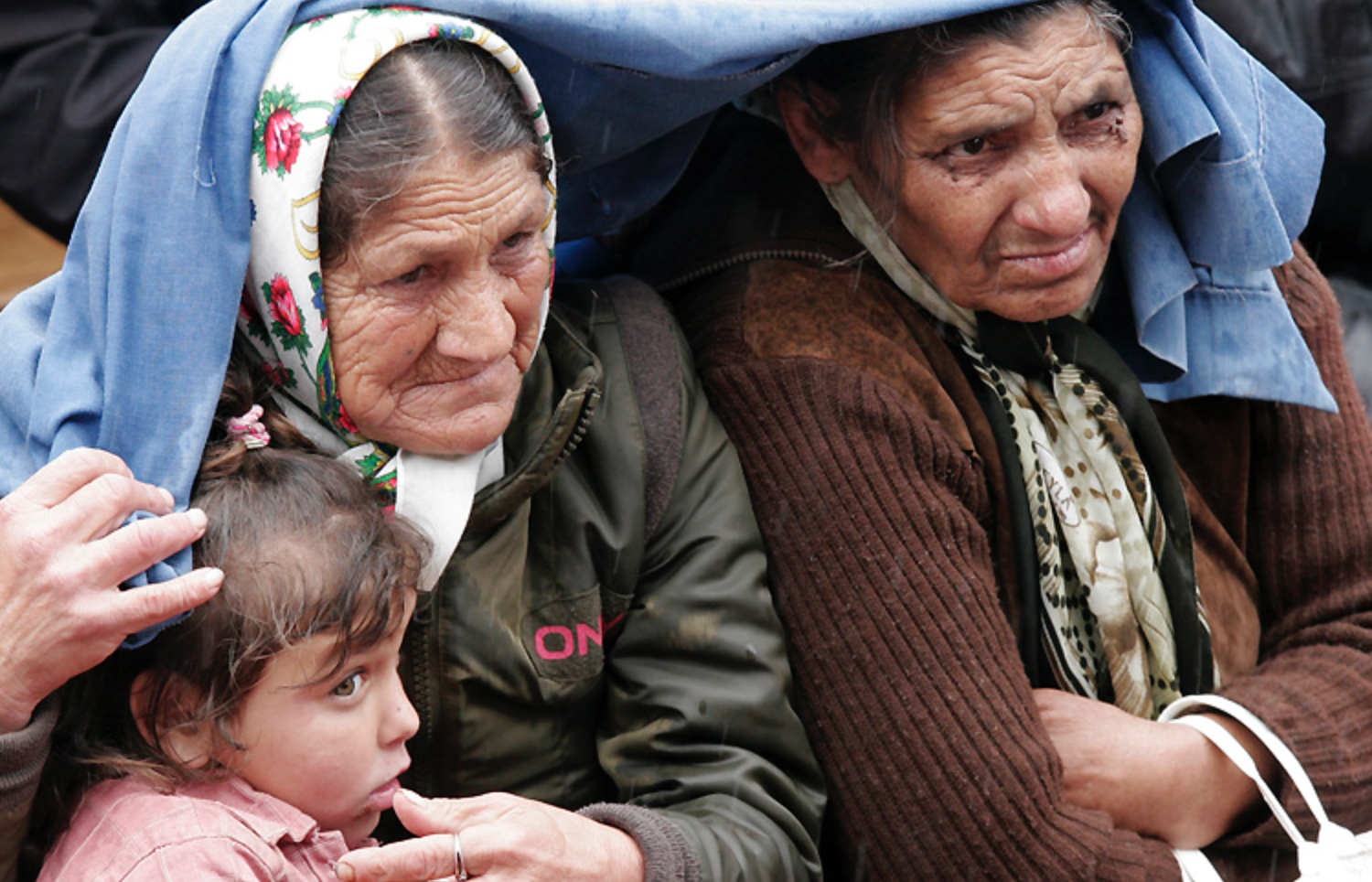
Gypsy Life

For my second documentary, I came across a photo story of gypsies in Romania. (Link here.)
I thought this was fitting, because it kind of goes along with the documentary above. Most of the people in that documentary were also gypsies.

I've seen this type of community before many times. On your way to the country side, or going to the mountains, or the beach you will encounter this type of view pretty often. I think that in a way it has it's own beauty to it.
In this photo story it's not really about a certain family, but about the gypsies in general. Each photo has a caption of a few words and there isn't really an order to it. If you were to rearrange each photo it wouldn't change the story.
As I was looking through the photos I've noticed that it's not too much different than the regular poor white people in Romania. They wear about the same sort of outfits and look way more aged than someone living in the upper class.


 In the image above it basically shows what the living conditions are for some white folks I know in Romania. Always strange colored walls, with at least 1 rug hanging on the wall.
One thing to take note of in the image above is the fact that they have a horse (here it'd be ridiculously expensive to own) and a buggy, or cart (or whatever you call them here). I personally know many people in the countryside that own horses and buggies that aren't rich at all. It's one form of transportation.
I think this photo story was well done, however I wish it was more story like and more personal. It seems kind of impersonal to me right now. I also wish there was more captioning or an article or something to go along with the images. The images do go well alone though.

Final Project Proposal.


For my final project, I would really like to do more House Shows, because it is definitely a very interesting scene that many people are not too familiar with. There is at least one House Show going on almost every weekend until the end of the semester. They take place in various locations, and are lots of fun to go to because no one judges you.
While the lighting is difficult to work with, I think it's a great chance to try and improve on that.
Currently, I don't know what I will be focusing on, but I'm thinking about possibly focusing on the crowd from the band's point of view. I think that would be interesting to see because the crowd tends to do strange things.
I was thinking of it into making a multimedia project or prints. I have a few ideas so far. If I go the multimedia way, I was thinking of filming and photos to give a better idea of what goes on, and maybe possibly get people to say whatever they are thinking or feeling. It'd be relatively easy to get people to say things because they're all very open people and blurt out whatever anyway. If I go the prints way, I really liked the idea of having writing to go along with it. For this I was thinking to get people to write stuff down on paint samplers that you can get for free at Home Depot.

Monday, February 23, 2015

Photo Story: Thon-A-Thon House Show

Caladan


 Honduras


Butterfly man

Head bobbing


*serious faces & smile*

College house show

Sunflower Bean 


Beans
_________________________________________________________________________________
This weekend I attended 2 different house shows. The first house show I went to was on Friday night and only got to see the second band, because I got there late and neighbors threatened to call the cops. Not only did I not get too many photos of that night, but it also ended early because of the neighbors.
The second house show is shown above. It's the most interesting house show I've been to so far and also my favorite for a variety of reasons. 
Some very interesting things happened and I managed to get most of it on video. One of the things that happened was someone decided to smash his TV. It was kind of disappointing because it didn't go as I thought it would. 
The bands all did a good job and kept up good energy. Personally, I enjoyed Honduras' set best (it's more my style), but Sunflower Bean did a really awesome job too. If either of them come back, I'm more than willing to see them again.
The lighting was difficult for me to work with, because I have no experience with low lighting and lots of movement. I did the best I possibly could for something I've never done before.

Wednesday, February 18, 2015

Response: Let Us Now Praise Famous Men by James Agee and Walker Evans

Before I respond to the reading I would like to share a few things about the documentary we watched that went along with this book. The documentary was paralleled to Let Us Now Praise Famous Men to more recent times, and by recent I mean the 80's.
It made me realize that no matter where in the world you are, people share similarities. For example, the poor in this country share many of the same experiences as the poor from a country in Eastern Europe. (I say Eastern Europe, because I have been and experienced that sort of life in some ways, first hand.) The same goes for middle and upper classes.
In class we were asked why there was a photographer and a journalist working together on this. I responded with something along the lines of, "Two minds work better together and with four eyes, you can see more things together. You each have different perspectives on things too. It's interesting to share your experiences through different means, in this case, photography and writing."
Anyway, the first thing that intrigued me before even starting to read the passages assigned, was the way the book is laid out. The images went in the very front of the book and the text followed after the last image. This is how I tend to lay things out for my own blog, but I sometimes add captions to each image.
I found it extremely difficult to read it, because many times I was lost in a sea of words. The way it is written confused me. I, myself, don't think am a great writer, in fact, I think I need a lot of improvement, but the way he used punctuation made me need to reread everything at least 5 times before understanding what he was trying to say. There was also far too much detail which sometimes made me bored, so I'd skim over it instead.
To give you an idea of his writing:

Found on page 6.
Towards the end of the first chapter before he starts to talk about the people in the book, I question his sanity.

The way he described the people (physically) was mildly disturbing. It was mostly about how he saw the women, which personally bothered me. If you are going to describe people, describe men, women and everything in between, not just one gender. I didn't like how after all of that he says, "I am only human."
Something I didn't fully understand was why he was trying to tell their story through "their eyes" rather than his own point of view. While I understand that it would be more accurate in some sense, I kind of wish it was more so from his point of view.  Something I kept wondering about is when (what time of day/night) he would write about all of this.
Overall, I see his writing very journal like. He just writes without stopping to think about his writing style and where punctuation needs to be put in. He doesn't seem to care for starting a new sentence. There's an awful lot of run-on sentences. Thank God I am not an English major or I might have gone crazy.